Mining Rare Earth Metals & Minerals

The rare earth elements (RRE) market was valued at $10.6BN USD in 2021. It is expected to more than double in size to $22.4BN USD, by 2032.

In response to China’s dominance in the global REE sector, North America is positioned to become the largest producer of Rare Earth Metals and Minerals in the World, with over a trillion dollars earmarked for investment over the next twenty years.

Rare earth elements (REE) refer to a group of 17 naturally forming elements in the lanthanide series in the periodic table of elements, including scandium and yttrium. The characteristics of the latter elements possess similar properties to the lanthanides.

The 17 Rare Earths are cerium (Ce), dysprosium (Dy), erbium (Er), europium (Eu), gadolinium (Gd), holmium (Ho), lanthanum (La), lutetium (Lu), neodymium (Nd), praseodymium (Pr), promethium (Pm), samarium (Sm), scandium (Sc), terbium (Tb), thulium (Tm), ytterbium (Yb), and yttrium (Y)

REEs are essential components needed to build and operate electronic devices that we use everyday, such as smart phones, digital cameras, computer hard disks, fluorescent and light-emitting-diodes (LED) lights, flat screen televisions, computer monitors, and electronic displays, smart phones, fluorescent and light-emitting-diode (LED) lights, flat screen televisions, computer monitors, lights, screens, and electronic displays. Large quantities of some REEs are used in clean energy and defense technologies.

REEs are used individually or in combination to make phosphors—substances that emit luminescence—for many types of ray tubes and flat panel displays, in screens that range in size from smart phone displays to stadium scoreboards. Some REEs are used in fluorescent and LED lighting. Yttrium, europium, and terbium phosphors are the red-green-blue phosphors used in many light bulbs, panels, and televisions. The glass industry is the largest consumer of REE raw materials, using them for glass polishing and as additives that provide color and special optical properties. Lanthanum makes up as much as 50 percent of digital camera lenses, including cell phone cameras.

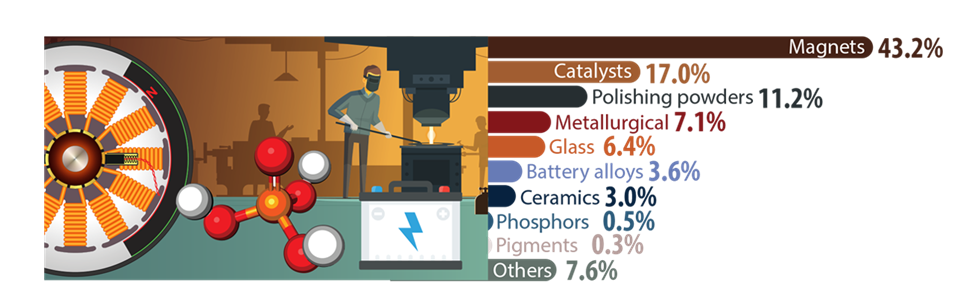
As catalysts

Lanthanum-based catalysts are used to refine petroleum. Cerium-based catalysts are used in automotive catalytic converters.

In magnets:

Magnets that employ REEs are rapidly growing in application. Neodymium-iron-boron magnets are the strongest magnets known, useful when space and weight are limiting factors. Rare-earth magnets are used in computer hard disks and CD–ROM and DVD disk drives. The spindle of a disk drive attains high stability in its spinning motion when driven by a rare-earth magnet. These magnets are also used in a variety of conventional automotive subsystems, such as power steering, electric windows, power seats, and audio speakers.

In batteries:

Nickel-metal hydride batteries are built with lanthanum-based alloys as anodes. These battery types, when used in hybrid electric cars, contain significant amounts of lanthanum, requiring as much as 10 to 15 kilograms per electric vehicle.

In steel alloys:

Cerium, lanthanum, neodymium, and praseodymium, commonly in the form of a mixed oxide known as mischmetal, are used in steel making to remove impurities and in the production of special alloys.

Lithium, nickel, cobalt, manganese and graphite elements are used to enhance and extend battery storage and performance. Rare earth elements are essential for magnets used to design, build and operate wind turbines and EV motors.

Applications

REE Market facts – North America

  • North America holds some of the largest known reserves and resources of RREs in the world, with an estimated value of 15.1 million tonnes of rare earth oxide. (2022)
  • Manufacturing permanent magnets is the largest global use for REEs, accounting for 43% of total demand in 2021.
  • China is currently the largest global producer of REEs, with an estimated 180,000 tonnes of REEs reported in 2021, accounting for 61% of global REE production.
  • Canada is increasingly seen as a major global source of RRE

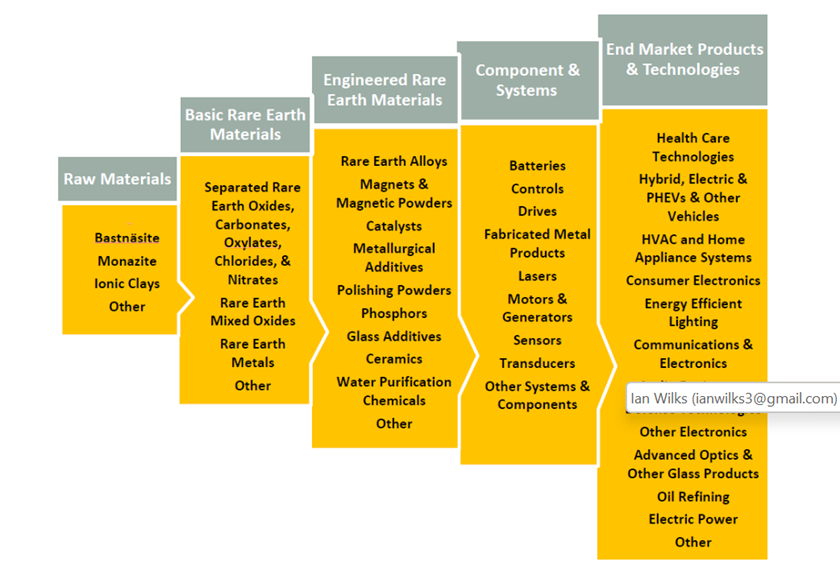
Rare Earth Metals Value-chain

Exploration process for REE

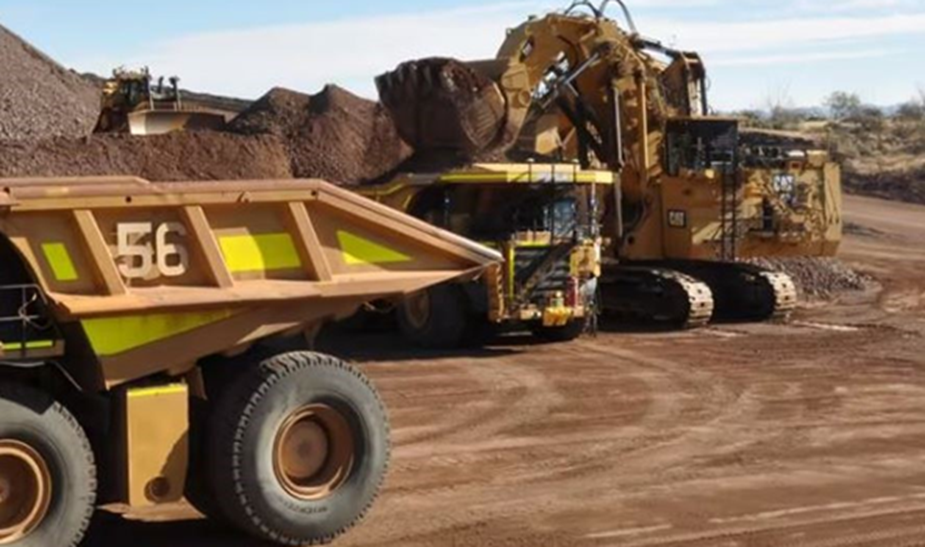
Mining Rare-earth ores is typically done by conventional open-pit methods in which quarry face rock is blasted and loaded into large dump trucks using large shovels. The materials are then transported to a materials separation plant, separating the rocks fragments from REE-bearing minerals.

We Support Your Project Through The Eight Stage Process​

Our Partnership network comprises Science and Technology experts, Market sector leaders and Project Managers, well-versed in mining exploration and recovery. We can guide your project through each stage in the process from mine sourcing, feasibility studies, regulatory and permitting to equipment sourcing, mineral exploration and recovery.

UpstreamMidstreamDownstream End products
1. Sourcing, permitting Mining operations3. Hydrometallurgy5. Metals smelting, alloys7. Equipment manufacturing
2. ORE Concentration4. RRE materials separation6. Magnet manufacturing8. Magnet manufacturing

Mining and Rare Earth Metals Projects